
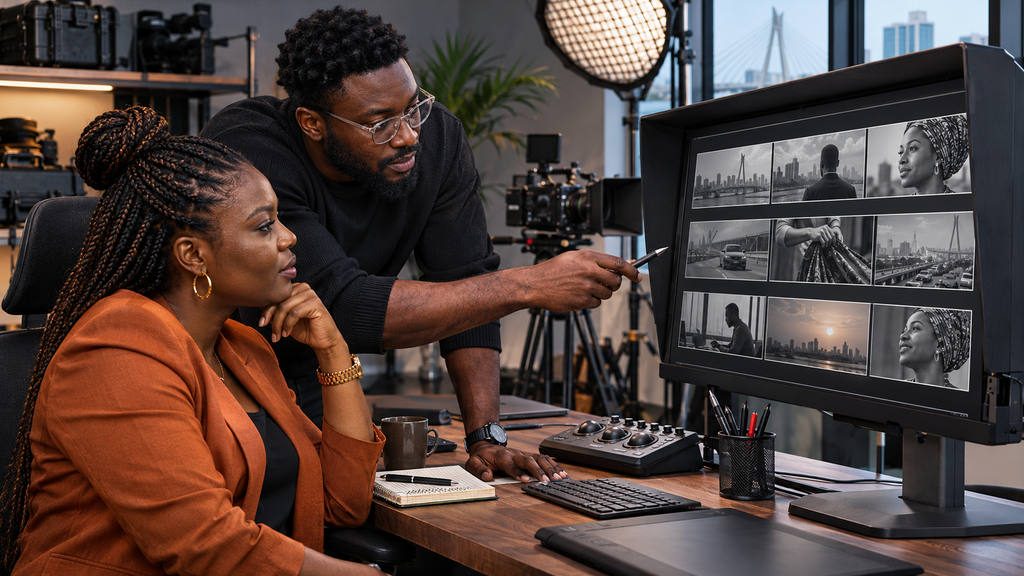
AI Video Production for Nigerian Businesses: 9 Things to Check Before Publishing an AI-Generated Advert
Imagine a Nigerian skincare brand preparing to launch a new product.
Its marketing team wants a cinematic commercial showing the product in a luxurious bathroom, surrounded by beautiful lighting, flowing water and carefully styled details.
Traditionally, producing that scene might require a location, props, lighting equipment, a camera crew and several hours of filming.
Today, AI tools can help create or modify elements of such a commercial without physically building every scene.
That opens interesting possibilities for businesses with ambitious creative ideas.
But it also introduces a question that deserves more attention: Just because AI can generate a convincing advert, does that mean the advert is ready to publish?
The answer is no.
AI video production for Nigerian businesses should involve more than entering a prompt, generating a video and adding a company logo.
Marketing teams must consider product accuracy, brand identity, intellectual property, audience expectations and the message the finished video communicates.
Here are nine checks worth completing before approving an AI-generated commercial.
1. Confirm that the product looks like the real product
This is one of the most important checks for any product advertisement.
AI systems can create convincing packaging, labels, colours and product shapes. However, those details may not match the actual item being sold.
Imagine a beverage company generating a commercial featuring its new bottled drink.
The AI-generated bottle looks attractive, but the cap is different, the label contains incorrect information and the bottle appears larger than the actual product.
Even if the video looks professional, it may create the wrong expectations.
Before approving the commercial, compare every product shot against approved photographs or physical samples.
Check the shape, colour, packaging, label, proportions and visible features.
For products where accuracy is essential, using real product photography or footage within an AI-assisted workflow may be safer than generating the product entirely from scratch.
2. Make sure the advert does not promise something the product cannot deliver
A visually impressive commercial can communicate claims without explicitly stating them.
Consider an AI-generated advert showing a cleaning product removing a stubborn stain instantly.
If the product cannot actually produce that result, the visual may mislead customers.
The same concern applies to cosmetics, financial services, healthcare products, property developments and other industries where consumers rely on accurate information.
The US Federal Trade Commission’s advertising guidance explains the importance of truthful, evidence-based advertising claims. Although this guidance describes US requirements rather than Nigerian law, the underlying principle is useful for any responsible marketing team: visual claims should be supportable. Federal Trade Commission
Ask your team what an ordinary viewer is likely to believe after watching the advert.
If the answer goes beyond what your product genuinely offers, revise the creative concept.
3. Protect your brand identity
A brand is more than its logo.
It includes visual style, colours, typography, tone of voice, product presentation and the way the company communicates.
AI-generated visuals can sometimes introduce unexpected variations.
A logo may appear stretched. Brand colours may change between scenes. Packaging might contain misspelled words. A character’s clothing may change unexpectedly.
These details can make a commercial feel inconsistent.
Create a reference pack before production begins. Include approved logos, brand colours, product photographs, packaging references and examples of the visual style you want.
Use actual brand assets wherever possible rather than asking AI to recreate them from a text description.
This is particularly important when creating multiple versions of a campaign for Instagram, Facebook, LinkedIn and other channels.
Consistency should be checked across every final export, not only the first version.
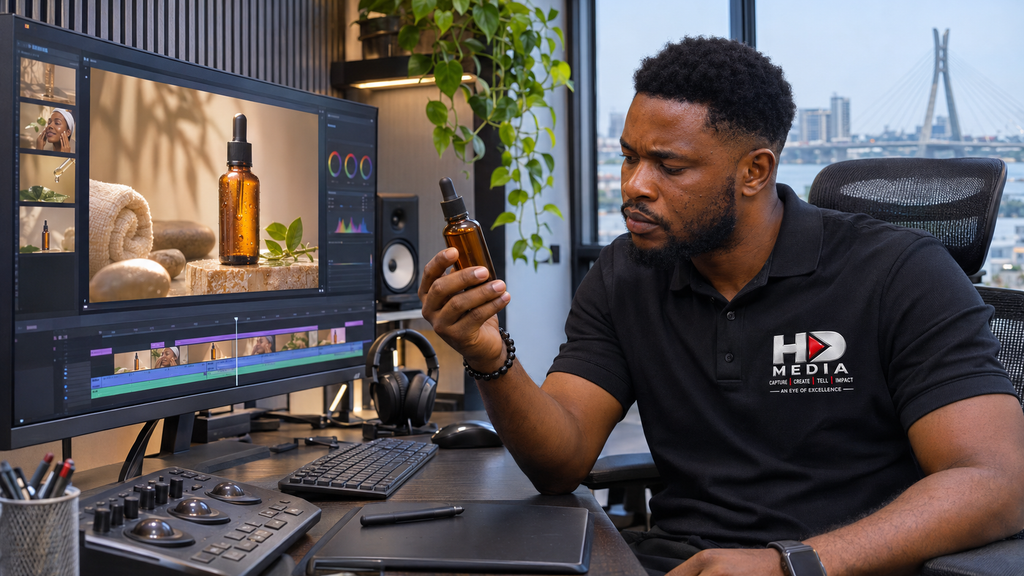
4. Decide whether AI is genuinely the right production method
AI is a production option, not a requirement.
Some advertising concepts benefit from generated environments, visual effects or imaginative scenes that would be difficult to create physically.
Others depend on authenticity.
A corporate video introducing a company’s real leadership team should ordinarily show those actual people.
A manufacturing business demonstrating its production facility should use accurate footage of that facility when the purpose is to show customers what exists.
A property company promoting a completed building should not substitute an invented environment that misrepresents the property.
The best approach may combine real footage with AI-assisted editing, backgrounds or motion graphics.
When considering AI video production for Nigerian businesses, begin with the communication objective.
Ask what must be real, what may be illustrated and what could be enhanced without changing the facts.
5. Check people, voices and permissions
AI tools can generate realistic faces and voices.
That capability requires careful handling.
Do not assume that because a system can imitate a person’s appearance or voice, your company has permission to use that likeness commercially.
If a campaign involves an identifiable individual, obtain appropriate authorisation before using or altering their image or voice.
Avoid generating fictional testimonials that appear to come from genuine customers.
Similarly, do not create a realistic executive endorsement that the executive never gave.
If you use synthetic presenters or characters, consider whether the audience could mistake them for real employees, customers or public figures.
Clear communication about the nature of the content helps reduce that risk.
For sensitive campaigns, involve your legal or compliance team before publication.
6. Review AI-generated scenes for misleading realism
An AI-generated scene can look like documentary footage even when the event never happened.
Imagine a company creating a promotional video showing a large crowd celebrating a product launch that has not yet taken place.
Viewers may interpret that footage as evidence of a successful real-world event.
The problem is not that the scene was created with AI. It is that the presentation could mislead people about what actually occurred.
YouTube’s official AI content disclosure guidance requires creators to disclose certain realistic AI-generated or meaningfully altered content, including realistic scenes that did not occur. YouTube Help
Check the rules of each publishing platform before uploading.
Where necessary, identify content as an illustration, simulation or AI-generated visual rather than presenting it as real footage.
7. Examine the small details before approving the video
AI-generated videos may look convincing at first glance but reveal problems during closer inspection.
Hands can move unnaturally. Objects may change shape. Text may become distorted. Background elements can appear and disappear between frames.
A person may hold a product differently from one shot to another, or a reflection may not match the object in front of it.
These issues matter because they can distract from the message.
Review the finished video on a large monitor and a mobile phone.
Watch it at normal speed, then inspect important frames individually.
Pay particular attention to product shots, human movement, text, logos and transitions.
The US National Institute of Standards and Technology’s AI Risk Management Framework resources provide broader guidance on evaluating and managing AI-related risks, including testing and verification. AIRC
For advertising production, the practical lesson is straightforward: generated content still requires human quality control.
8. Understand the rights attached to your creative assets
Before commissioning or producing an AI-assisted commercial, clarify the usage rights.
Can the generated material be used commercially under the relevant tool’s terms?
Does the soundtrack have an appropriate licence?
Are any stock photographs, voice recordings or third-party designs included?
Can your business reuse the finished video in future campaigns?
Also establish who owns or controls the final files and which editable materials will be delivered.
Rights involving AI-generated material can be complicated and may depend on the applicable laws, platform terms and human creative contributions.
Avoid assuming that every generated asset is automatically exclusive to your company.
For significant advertising campaigns, have the relevant contracts and licences reviewed before publication.

9. Keep human creative direction at the centre
One of the easiest mistakes is allowing the AI tool to determine the entire creative direction.
The result may look impressive but communicate very little about the business.
A good commercial still needs a clear audience, message and purpose.
Before generating scenes, prepare a brief that explains the product, the intended customer, the main benefit, the tone and the desired action.
Then develop a storyboard.
Decide which scenes should use real footage, which could benefit from animation and where AI-generated elements would genuinely add value.
The production team should still evaluate pacing, sound, colour, editing and visual continuity.
AI can assist with execution, but it should not replace the judgement needed to create relevant, accurate advertising.
Businesses exploring different approaches can review HDMedia’s video, motion graphics and AI-assisted production services to understand how these capabilities can fit within a broader creative workflow.
A practical approval checklist for AI-generated commercials
Before your marketing team approves an AI-assisted advert, confirm the following:
- The product, packaging and brand assets are accurate.
- Visual claims match what the product or service genuinely delivers.
- The creative approach suits the intended audience.
- Identifiable people and voices are used with appropriate permission.
- Fictional scenes are not presented as real events.
- The video has been checked for visual inconsistencies.
- Music, images and other assets have suitable usage rights.
- Platform disclosure requirements have been reviewed.
- The final edit has received marketing, brand and relevant compliance approval.
Not every project will face the same risks. A fictional animated story has different requirements from a realistic product demonstration or executive announcement.
The important thing is to evaluate the actual content rather than treating every AI-generated video identically.
How should Nigerian businesses budget for AI video production?
AI-assisted production may reduce the need for certain physical locations, props or shooting arrangements.
However, it does not eliminate the work involved in creative planning, generating usable scenes, correcting errors, editing, sound design and final quality assurance.
A commercial containing many realistic characters or complex product movements may require considerable revision.
When requesting a quotation, explain your intended message, visual style, duration, delivery formats and which elements must be accurate representations of real products or people.
Ask the production team to separate essential deliverables from optional creative enhancements.
This helps you evaluate the production approach instead of choosing a solution solely because it is described as AI-powered.
Conclusion: Use AI to strengthen the idea, not replace responsibility
AI video production for Nigerian businesses creates opportunities to explore imaginative advertising concepts and more flexible production workflows.
But creative possibilities should never come at the expense of accuracy, trust or brand consistency.
The strongest approach is to combine new technology with sound production judgement.
Use AI where it genuinely improves the creative process. Use real footage where authenticity matters. Review every claim and visual before publication.
If your company is considering an AI-assisted commercial or a campaign combining filmed footage, animation and digital effects, contact HDMedia to discuss a production approach that fits your message and brand requirements.