
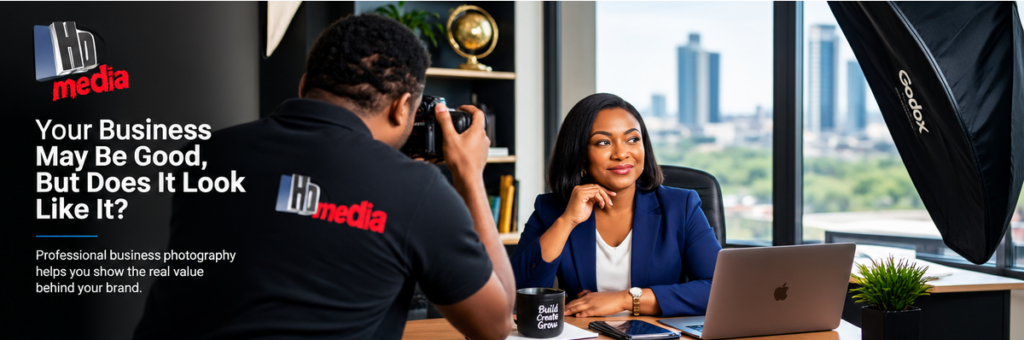
You can have a great product, excellent service, a talented team and years of experience behind your business.
But before a potential customer experiences any of that, they usually see how your business presents itself.
They see your website. Your social media pages. Your LinkedIn profile. Your team photographs. Your company profile. Your proposals. Your advertisements.
And in many cases, those images become part of their first impression of your business.
That raises an important question:
Does the way your business looks communicate the quality of the business you have actually built?
Professional business photography is not simply about making people or products look attractive. It is about creating visual communication that helps people understand your business, trust it and remember it.
Your Business Has More Visual Touchpoints Than You Think
Think about all the places where someone might encounter your business before they ever speak to you.
Your website may introduce your company.
Your LinkedIn profile may introduce your leadership team.
Instagram may show your products, services or company culture.
A proposal may include photographs of your team or previous work.
A company profile may require professional portraits.
A presentation may need photographs that make the business feel established and credible.
Even a simple “About Us” page can communicate a lot through imagery.
That means your business photography is rarely limited to one photoshoot or one profile picture.
It can become part of your entire visual identity.
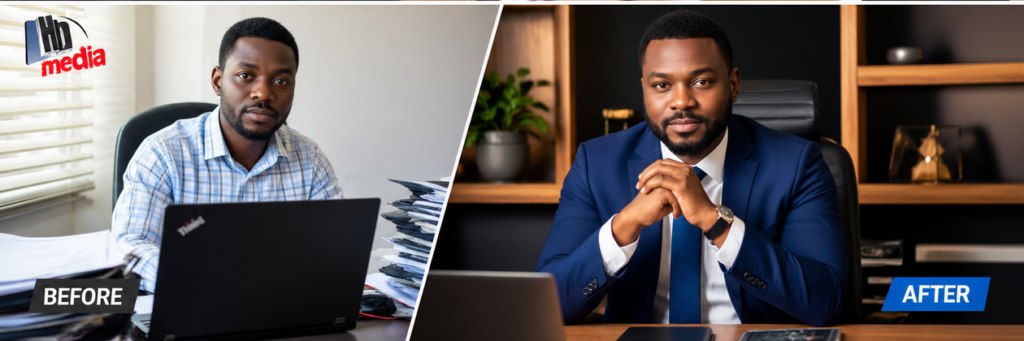
The way a business is presented visually can influence the impression people form before they experience the business itself.
The important thing is not to treat this as a literal “before and after” transformation. The image is simply illustrating the difference that intentional visual presentation can make.
A strong business does not necessarily need to look flashy.
It needs to look intentional, credible and consistent with what it offers.
Why Professional Business Photography Matters in Nigeria
Nigeria’s business environment is highly competitive.
From Lagos startups and professional service firms to established companies, creative businesses, restaurants, real estate companies and growing SMEs, businesses are constantly competing for attention.
And much of that competition now happens online.
A potential client can compare several companies within minutes.
They may visit your website, check your social media page, look at your team and search for examples of your work before deciding whether to contact you.
This is where professional photography can make a difference.
Good photography can help your business:
- Present a more consistent visual identity
- Build confidence with potential customers
- Give your website a more professional appearance
- Strengthen your social media presence
- Create better marketing materials
- Present your team and leadership professionally
- Build a reusable library of visual content
This doesn’t mean photography alone determines whether someone chooses your business.
Your product, service, reputation, customer experience and results still matter.
But photography can help ensure that your visual presentation doesn’t undersell the quality of everything else.
What Should Your Business Photography Actually Communicate?
A professional photograph should do more than show what someone looks like.
It should communicate something about the business.
Ask yourself:
What should someone feel when they see this photograph?
Should they see expertise?
Confidence?
Approachability?
Innovation?
Trust?
Energy?
Premium quality?
Reliability?
The answer depends on the business.
A lawyer may need photographs that communicate professionalism and confidence.
A technology company may want something modern and energetic.
A creative agency may want something more expressive.
A healthcare business may need warmth and trust.
A founder may need photographs that feel authoritative without looking overly formal.
The objective isn’t to make every business look the same. The objective is to make the right visual impression for that particular business.
Move Beyond the Standard Headshot
A professional headshot is useful.
But it doesn’t have to be the only photograph you create.
Think about the different sides of your business that customers may want to see.
You could photograph:
- Leadership and management
- Team members
- Employees at work
- Customer-facing staff
- Products
- Services being delivered
- Your workspace
- Behind-the-scenes processes
- Meetings and collaboration
- Company culture
- Events
- Brand details
These images tell a much bigger story than a collection of headshots.
For example, instead of simply showing a company’s managing director sitting behind a desk, you could show that person interacting with the team, meeting a client, reviewing work or participating in the company’s day-to-day operations.
That gives your audience context.
And context makes business photography more useful.
When Is a Phone Camera Enough?
Not every photograph needs professional equipment.
A phone camera can be perfectly appropriate for everyday social media updates, behind-the-scenes moments, quick announcements and informal content.
The problem comes when businesses use casual photographs for situations where professional presentation matters.
Your website’s main team photographs, executive portraits, company profile, major campaign images or important marketing materials may deserve a more deliberate approach.
The question isn’t:
“Can a phone take a good picture?”
Of course it can.
The better question is:
“Is this photograph important enough to deserve professional planning, lighting, direction and post-production?”
For some images, the answer will be yes.
Think of Photography as a Content Asset
One of the biggest mistakes businesses make is thinking of a photoshoot as producing only a few pictures.
A well-planned business photography session can create a visual content library that can be used for months.
One session might produce photographs for:
- Your website
- Company profiles
- Press releases
- Presentations
- Brochures
- Advertising
- Email campaigns
- Staff profiles
- Articles and blog posts
That changes the way you should think about the investment.
You aren’t simply paying for photographs.
You’re creating visual material that your business can continue using across different communication channels.
The key is planning the shoot around those future uses.
Your Photographs Should Fit Your Brand
Good photography isn’t necessarily the most dramatic photography.
It is photography that makes sense for your brand.
Think about your existing visual identity.
What colours does your business use?
What kind of customers do you serve?
Is your brand traditional or modern?
Formal or relaxed?
Corporate or creative?
Premium or accessible?
Your photographs should feel like they belong to the same business as your website, logo, social media and other marketing materials.
Consistency helps create recognition.
When your photographs, colours, design and messaging all work together, your business begins to feel more intentional.
Professional Doesn’t Have to Mean Stiff
There is a difference between professional and unnatural.
Professional business photography doesn’t mean everyone has to sit perfectly straight in a chair with their hands folded and a serious expression.
People want to see the human side of businesses too.
A natural smile.
A genuine conversation.
A team working together.
A founder interacting with employees.
A professional concentrating on their work.
A customer experience being delivered.
These moments can communicate professionalism while still feeling authentic.
The goal is not to create photographs that look overly staged.
It is to create photographs that show people and businesses at their best without losing their personality.
Plan the Shoot Around Your Business Goals
Before the camera comes out, you should know what you want the photographs to accomplish.
Start with a few simple questions:
Where will these images be used?
Website?
Social media?
Advertising?
Company profile?
Press?
LinkedIn?
Who needs to be photographed?
Founder?
Leadership?
Entire team?
Customers?
Products?
What does the audience need to understand?
Your expertise?
Your people?
Your process?
Your environment?
Your products?
Your personality?
Once those questions are answered, the shoot becomes much more purposeful.
You can plan locations, wardrobe, lighting, compositions and shot lists around the actual needs of the business.
That is much more effective than simply saying:
“Let’s take some nice pictures.”
What to Prepare Before a Business Photoshoot
A successful photoshoot doesn’t begin when the photographer arrives.
There are a few things you can prepare beforehand.
1. Know your objectives
Decide what you need the photographs to achieve.
2. Identify the people
Create a list of everyone who needs to be photographed.
3. Plan the locations
Consider your office, studio, business premises, outdoor locations or other environments that represent the company.
4. Prepare wardrobe
Choose clothing that fits your brand and makes the people being photographed feel confident.
5. Clean and organise the environment
Backgrounds matter.
Remove unnecessary clutter and distractions.
6. Create a shot list
Think about the photographs you will need for your website, social media and other marketing channels.
7. Allow enough time
Rushing a photoshoot can limit creativity and make people uncomfortable.
Good photographs usually benefit from preparation.
This Is Where the Right Production Partner Makes a Difference
Professional business photography isn’t simply about owning an expensive camera.
It involves understanding lighting, composition, direction, environment and the purpose of the final image.

Behind every strong business photograph is a process involving planning, lighting, composition and direction.
The photographer also plays an important role in helping people feel comfortable in front of the camera.
Not everyone is a professional model.
In fact, most business owners and employees aren’t.
A good photographer needs to know how to guide people through poses, expressions and positioning without making the session feel awkward.
The result should still look like the person — just presented in a way that reflects their professionalism.
This is one reason it is useful to work with a production team that understands more than just taking photographs.
HD Media, for example, works across photography alongside videography, live streaming, 3D and motion, and digital services. The company describes its approach as starting with the client’s goals and audience before moving into planning, shooting and delivery.
That broader production perspective can be particularly useful when a business needs photographs and other visual content to work together.
Your Next Photography Session Should Be Intentional
Before your next business photography session, don’t simply ask:
“What pictures do we need?”
Ask:
“What does our audience need to see?”
What do you want a potential customer to understand about your company?
What should they know about your people?
What should they feel when they visit your website?
What kind of impression should your leadership team create?
What visual content will your marketing team need over the next few months?
These questions can completely change the way you approach a photoshoot.
Instead of taking a few photographs and moving on, you start building a visual library with a purpose.
Your Business Has Already Done the Hard Work
You have invested time into building your business.
You have developed your products.
You have served customers.
You have built a team.
You have created systems.
You have gained experience.
You have earned your reputation.
Your photographs should help communicate that work.
They don’t have to make your business look bigger than it is.
They simply need to show your business clearly, professionally and authentically.
Because sometimes the problem isn’t that your business isn’t good enough.
The problem is that your visuals haven’t caught up with the quality of the business.
Frequently Asked Questions About Business Photography?
1. How often should a business update its professional photographs?
There isn’t one fixed schedule.
Businesses should consider updating photographs when their team changes, their brand identity changes, their appearance becomes outdated or they have significantly changed their products, services or environment.
For businesses that rely heavily on digital marketing, regular photography sessions can also help maintain a fresh supply of content.
2. What is included in professional business photography?
It depends on the project.
A session may include planning, location selection, lighting, professional photography, direction, image selection, editing and delivery.
The exact scope should be determined by what the business needs the photographs for.
3. Is professional photography necessary for a small business?
Not every photograph needs to be professionally produced.
However, important brand touchpoints — such as your website, leadership profiles, company profile and major marketing campaigns — can benefit from professional photography.
The goal is to invest where the images have the greatest impact.
4. How can business photography be used on social media?
Professional business photographs can become a versatile content library.
You can use them for:
- LinkedIn posts
- Instagram posts
- Team introductions
- Founder content
- Company announcements
- Behind-the-scenes content
- Promotional campaigns
- Educational posts
- Website content
A well-planned shoot can therefore provide much more than a single social media post.
5. How should a business prepare for a professional photoshoot?
Start by identifying your goals and where the photographs will be used.
Then prepare the people, wardrobe, locations, products and environments that need to be photographed.
A clear shot list can also help ensure that the session produces the variety of images your business actually needs.
Give Your Business the Visuals It Deserves
Your business has already done the hard work.
Now your visuals need to communicate that quality.
Professional business photography isn’t about pretending your business is something it isn’t.
It’s about presenting what you’ve built in a way that is clear, credible and consistent with your brand.
Whether you need corporate portraits, team photography, brand photography, product images or a broader visual content library, the most important thing is to approach the shoot with a purpose.
At HD Media, photography is part of a broader production capability that includes videography, live streaming, motion and digital services. The studio is based in Lagos and has been producing visual content since 2013.
If your business is ready for professional photographs that can work across your website, social media, marketing materials and brand communications, HD Media can help you plan and produce them.
Your business has a story. Let’s create the images that help people see it.
3 Responses